

Opinion by Ian Powell
The Kāpiti Health Advisory Group (KHAG) is a formal advisory committee of the Kāpiti Coast District Council (KCDC). Its members are all volunteers with an impressive range of varying experiences in different levels and parts of the health system. It is a valuable resource for KCDC.
Among many other things, KHAG publishes a regular newsletter. Last December it reported a disappointing but unsurprising situation:
…our primary objective – a major health facility for Kāpiti, such as a polyclinic—remains out of reach…
Until last July I was a member of KHAG when I resigned. Until then I was leading its work on access to healthcare. This involved a major initiative which became KHAG’s “primary objective”.
Compelling case for a polyclinic
The initiative was to present a case to KCDC to advocate to Health New Zealand for the incremental expansion of the treatment and diagnostic services provided at the HNZ-owned Kāpiti Health Centre in Paraparaumu. Over time it was envisaged that it would become a polyclinic covering both community and non-acute less complex hospital care (including urgent care).
A key part of this work involved me as the lead author of an evidence-based document called the Compelling Case arguing for the incremental expansion of KHC services into a polyclinic. This involved many voluntary hours researching invaluable but not widely known data, including under the Official Information Act, which confirmed two things – Kāpiti Coast’s population was disadvantaged in healthcare access compared with many other parts of New Zealand and that providing more services in a local polyclinic would benefit the wider regional health system, including Wellington Hospital.
Using my extensive contacts within the health system I also spent time ‘socialising’ this initiative with HNZ at various levels where is was positively received.
During March-April last year I spoke at 10 meetings in each of KCDC’s community board areas (five were public meetings and five were with the boards themselves). Support was overwhelming.
Consequently KCDC at its meeting in late May voted without dissent to support KHAG’s proposal. At KHAG’s next regular meeting (9 June) I emphasised the importance of maintaining traction with HNZ, being disciplined, and that KHAG should play the lead role in progressing the polyclinic initiative with HNZ (but in accordance with its accountability to KCDC). This was accepted. The Mayor and the councillor responsible for health were both present and were supportive.
Going off the rails
That proved to be the high point. Thereafter it went quickly downhill. Senior management (those who report directly to KCDC’s chief executive) saw otherwise. They took over the process; in effect, marginalising KHAG’s role. Unfortunately KHAG’s leadership was not sufficiently astute and firm to challenge the robustness of this change.
Progressing on the polyclinic was distracted by a focus instead on developing a more generalised memorandum of understanding between KCDC and Health NZ. The practical effect was to distract from the disciplined and sharp focus needed to progress the polyclinic initiative.
The traction needed if we were to have a chance of success was lost. The direction had been unilaterally shifted from a practical focus on expanding health services at KCDC to a ‘word salad talk-fest’.
KCDC senior management believed that it knew better than its advisory committee. However, their health system experience was 16 months working in the Ministry of Health.
Health ministry experience can be valuable but usually when that experience is preceded or followed by clinical or operational experience in the health system itself (primarily in public hospitals and/or community health providers). Without this experience is limited to a silo distant from the realities of healthcare.
I also became aware that within senior management there was a quiet promoting of private investor interest in the polyclinic. In other words, in order to maximise profitability, private investors would have a significant influence over the design, construction and operation of the polyclinic. Funding that might otherwise be spent on service expansion would be syphoned off into private profits.
Note: Private investors should not be confused with either philanthropy or collaborative relationships with the private sector (both of which can be beneficial).
Where responsibility lies
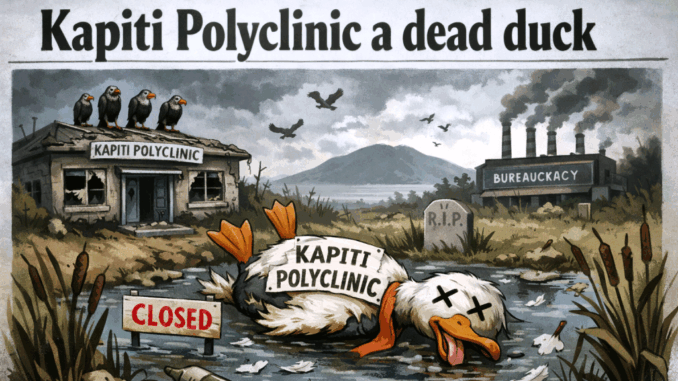
The acknowledgement by KHAG that the polyclinic initiative is now “out of reach” suggests that it has become a dead duck. This is different from reporting that it would take some time (the Compelling Case document itself made this clear as I also did at the 10 meetings I spoke at) and any steps being undertaken (no matter how small) towards the polyclinic objective.
Responsibility for this disappointing state of affairs does not rest with Health NZ. Instead it is an own goal by senior management not knowing what it didn’t know, driven too much by ego, and unilaterally taking control of the process. Traction and focus was lost; distraction was enhanced.
Dead ducks don’t quack; regrettably it seems that KCDC senior management has lost the polyclinic quack leaving the residents of the Kāpiti Coast the biggest loser.
This is an opinion piece by Ian Powell – Kāpiti based freelance writer on Health Systems and Policies